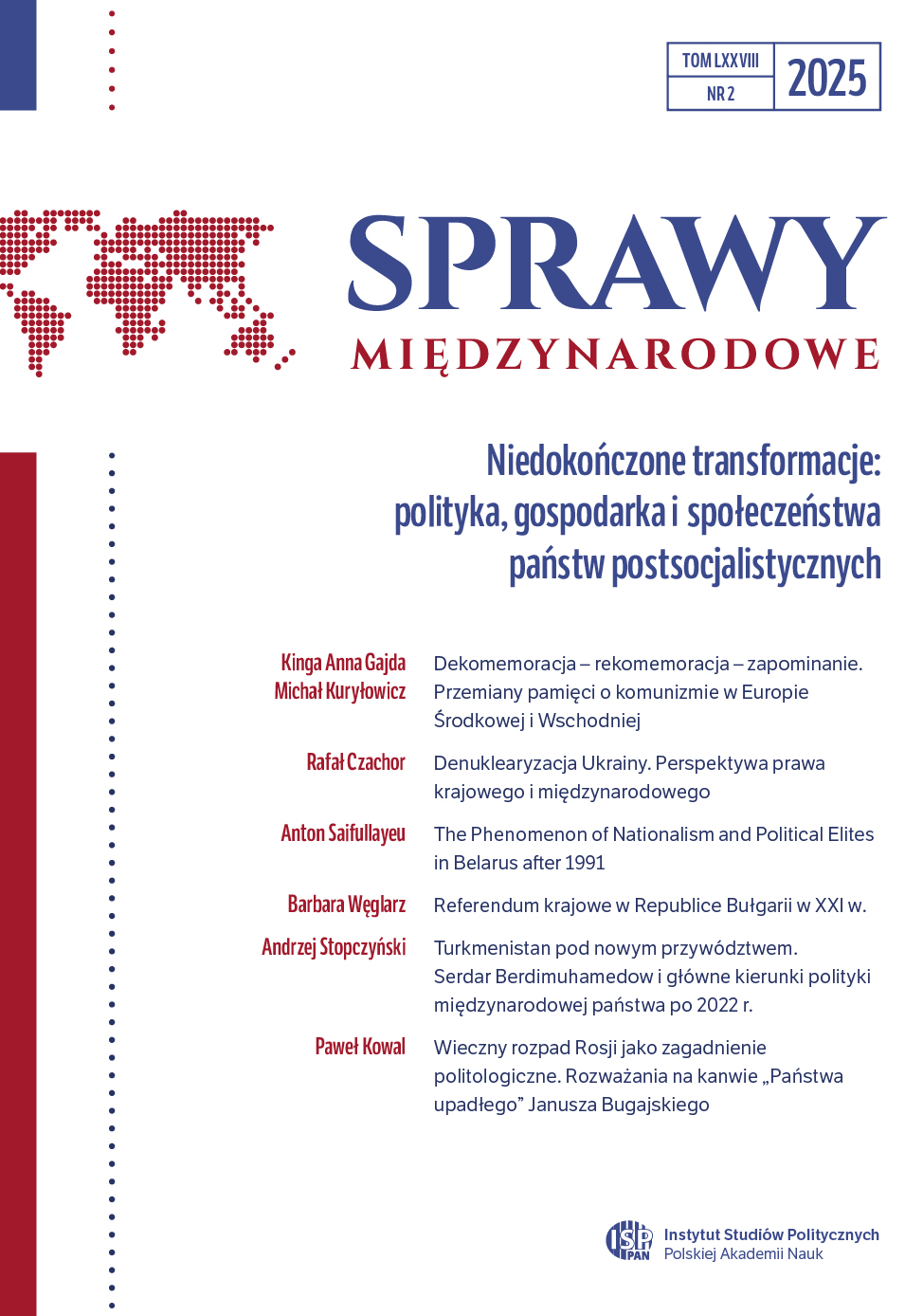
De-Commemoration – Re-Commemoration – Oblivion: Transformations of the Memory of Communism in Central and Eastern Europe 7–34 Kinga Gajda, Michał Kuryłowicz PDF (Język Polski)
Demographic and Economic Disparities of Post-Socialist and Western European Regions in the Light of Systemic Transformations 35–61 Anna Wichowska PDF (Język Polski)
Parliamentary Control over Civilian Secret Services in Poland and the Czech Republic 63–87 Witold Graca PDF (Język Polski)
Denuclearisation of Ukraine: Domestic and International Law Perspective 89–114 Rafał Czachor PDF (Język Polski)
Trends in the Development of Belarusian Studies in Poland after 2020: A Critical Analysis 115–136 Maxim Rust PDF (Język Polski)
The Phenomenon of Nationalism and Political Elites in Belarus after 1991 137–162 Anton Saifullayeu PDF
Belarusian Authorities in Exile after 2020 and the Operational Practices of Governments-in-Exile in the 20th Century 163–195 Michał Dworski, Mateusz Błaszczak PDF (Język Polski)
From Information to Propaganda: The Transformation of the Russian Media System 197–225 Taras Polovyi PDF (Język Polski)
National Referendum in Republic of Bulgaria in the 21st Century 227–248 Barbara Węglarz PDF (Język Polski)
Turkmenistan under New Leadership: Serdar Berdymukhammedov and the Directions of the Country’s Foreign Policy after 2022 249–273 Andrzej Stopczyński PDF (Język Polski)
Cybersecurity and Regional Security Perspectives – the Case of the South Caucasus Countries 275–303 Marek Górka PDF (Język Polski)
Eternal Disintegration of Russia as a Political Science Issue: Reflection on Janusz Bugajski’s “Failed State. A Guide to Russia’s Rupture” 305–318 Paweł Kowal PDF (Język Polski)
„Integracja europejska w teorii i praktyce. Korzyści i wyzwania członkostwa Polski w Unii Europejskiej”: red. Bogumiła Mucha-Leszko, Elżbieta Kawecka-Wyrzykowska, Polskie Wydawnictwo Ekonomiczne, Warszawa–Lublin 2025, 412 pp. 319–326 Danuta Hübner PDF (Język Polski)